

Elementary Mathematics Education(Elem Math Educ)_小学数学教育
Time:2026-07-08 Visits:0
Elementary Mathematics Education Major
Elementary mathematics education Major serves as the cornerstone of the foundational education system, specifically training teachers to guide children in developing mathematical thinking and establishing a foundation for lifelong learning. In 2026, as the world collectively faces a “teacher shortage” and AI reshapes educational models, this discipline is undergoing a profound transformation—shifting from “knowledge transmission” to “thinking cultivation,” and from “experience-based teaching” to “evidence-based education.”
Introduction to the Elementary Mathematics Education Major
Elementary Mathematics Education Major is a specialized discipline focused on effectively teaching mathematical concepts, cultivating mathematical thinking, and developing problem-solving skills in children (typically aged 5-12). It integrates mathematical subject knowledge, child development psychology, pedagogy, and curriculum design theory to train educators who are both mathematically proficient and child-centered.
If a child's learning journey is likened to constructing a building, elementary math teachers lay the foundation—helping children establish the cornerstones of number sense, spatial awareness, and logical reasoning. These foundations support all future learning in science, technology, engineering, and economics. The core mission of this program is “to enable every child to develop a positive relationship with mathematics and cultivate lifelong mathematical thinking.”
International Perspective: Primary mathematics education occupies a central position in educational systems worldwide. Western countries emphasize “child-centered” pedagogy and inquiry-based learning; Singapore and East Asian regions excel in “model-based approaches” and problem-solving; Nordic nations like Finland prioritize cultivating mathematical interest through play and hands-on activities. This is a highly internationalized discipline closely aligned with national education strategies and characterized by stable societal demand.
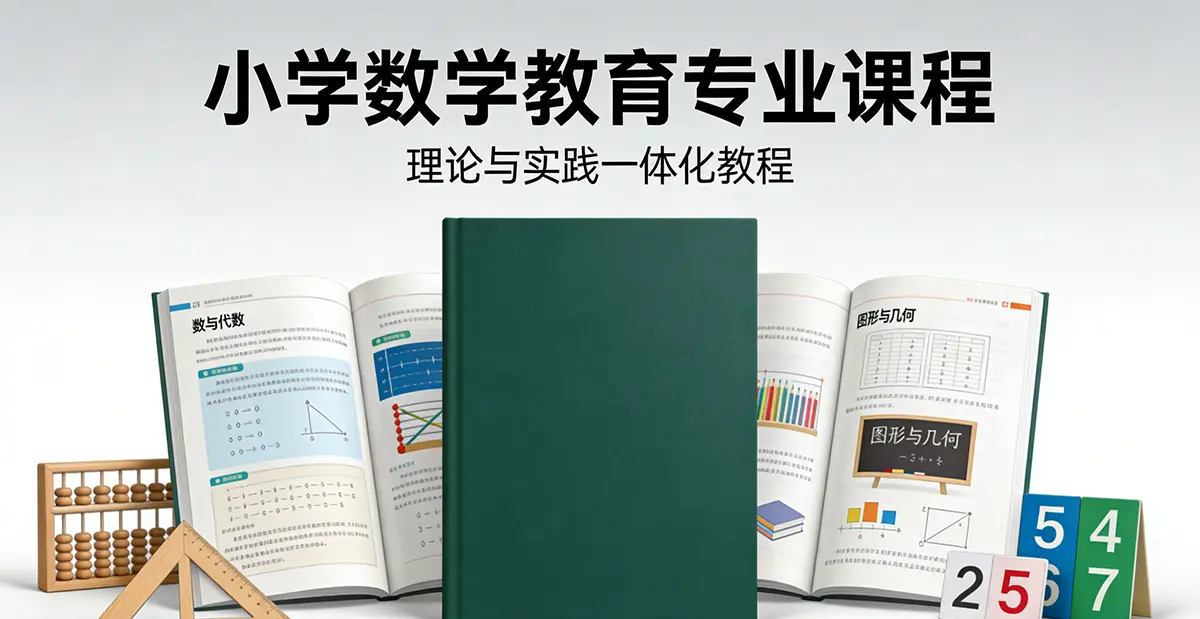
Core Curriculum Modules at International Institutions
Top international universities' elementary mathematics education programs emphasize a trinity of “theory + practice + reflection,” typically integrating mathematical content knowledge, pedagogical knowledge, and understanding of child development.
Core Curriculum Modules (Example: University of Edinburgh, UK):
| Course Category | Core Content | Learning Objectives |
| Deepening Mathematical Content Knowledge | Development of number concepts (from early counting to fractions, decimals, percentages); computational methods (mental strategies to written procedures); geometry, position, and motion; foundations of mathematical and algebraic thinking; probability and data handling | Progressing from “knowing what” to “understanding why,” building deep pedagogical understanding |
| Pedagogical Knowledge | Application of learning theories in mathematics; analysis of common concepts, misconceptions, and difficulties; targeted instructional strategy design | Develops “subject-specific pedagogical knowledge” to diagnose and address student learning needs |
| Curriculum and Assessment | Interpretation of national mathematics curriculum standards; formative and summative assessment design; learning trajectory analysis | Enables evidence-based teaching adjustments to support each student's development |
| Child Development Psychology | Stages of children's cognitive development; Patterns of mathematical thinking development; Learning motivation and affective factors | Understanding how children learn mathematics to design age-appropriate instructional activities |
Typical Course Content (Example from University of Edinburgh's “Primary Mathematics Education” program):
- Development of Number Concepts: Focusing on concrete representations and operational practices of early number concepts, extending to understanding fractions, decimals, and percentages
- Computational Approaches: Exploring the progression from mental calculation strategies to informal recording to appropriate written methods, grounded in current research
- Geometry, Position, and Motion: From early shape experiences to technological exploration using programmable toys and “turtle” graphics
- Mathematical Thinking Development: Extending to the foundations of “generalization” and mathematical proof, incorporating age-appropriate algebraic thinking
- Data and Uncertainty: Developing understanding of chance and uncertainty, cultivating critical mathematical literacy relevant to civic engagement
Assessment Methods:
- Knowledge Audit and Self-Assessment: 20% course credit, completing subject knowledge audit and self-assessment, writing reflective commentary
- Open-Book Exam: 80% course credit, assessing understanding of student mathematical thinking development and related pedagogies
- Group Online Presentation: Formative assessment showcasing a specific theme in elementary mathematics instruction
Practical Components (Integrating International Training Models):
- Clinical Practicum: Students complete extended field experiences in programs such as Western Washington University
- Teaching Practice: Apply learning in authentic classrooms under mentor guidance and peer feedback
- Action Research: Conduct research and write reports addressing challenges encountered in teaching practice
Advanced Study Directions for Elementary Mathematics Education Major
Research at the master's and doctoral levels is highly specialized and cutting-edge, primarily covering the following areas:
Core Research Directions (Based on Xinyang Normal University Master's Theses and Jiangsu Institute of Technology Team Research):
| Research Direction | Research Content | Application Areas |
| Mathematics Curriculum and Pedagogy | Unit-based instructional design, interdisciplinary assignment design, integration of math history into teaching, application of performance-based assessment | Curriculum development, instructional design optimization |
| Mathematics Learning and Development | Elementary students' math learning motivation, cultivation of number sense, deep learning assessment, intervention for academically disadvantaged groups | Differentiated instruction, learning support |
| Mathematics Education Assessment | Classroom teaching quality evaluation, student academic assessment, assessment tool development | Educational evaluation, teacher reflection |
| Mathematics Educational Technology | AI-enhanced mathematics education, digital tool applications, online learning platform design | EdTech, smart teaching |
| International Comparative Research | Comparative analysis of national mathematics curricula, textbook development comparisons, cross-cultural pedagogy studies | Curriculum reform, textbook development |
| Cultivating Elite Innovative Talent | Identification and nurturing of gifted math students, math competition coaching | Gifted education, competition guidance |
International Career Paths and Positions
Graduates in Elementary Mathematics Education are in high demand globally, with career opportunities extending beyond traditional school teaching into edtech, publishing, consulting, and other fields.
Core Employment Sectors:
| Sector | Typical Employers | Representative Positions |
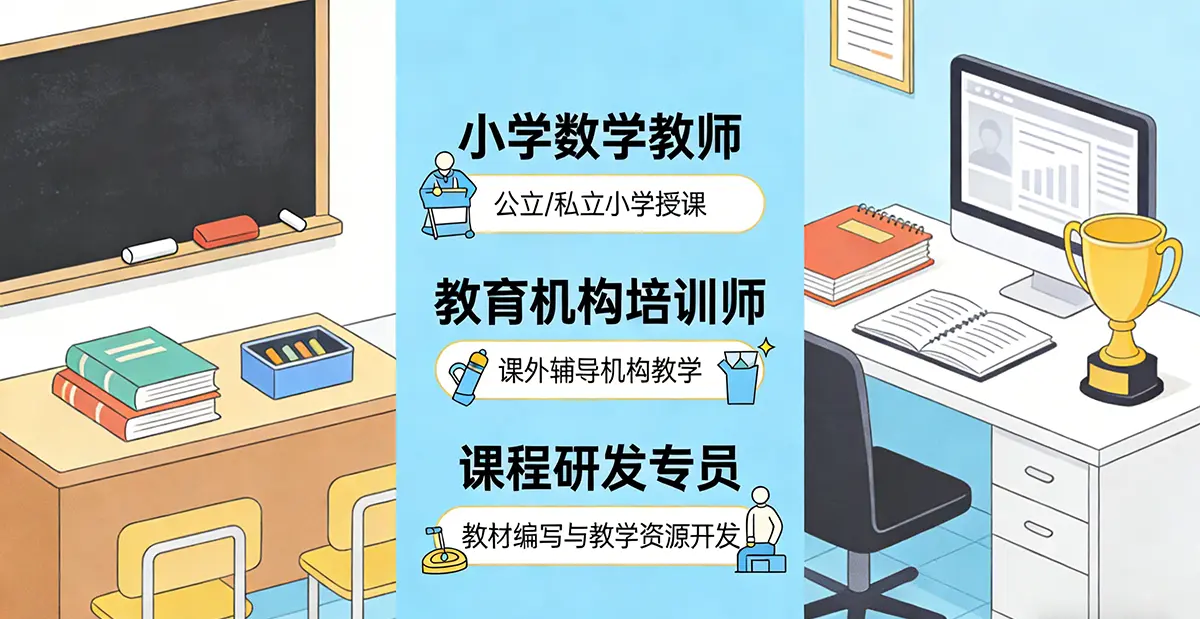
| School Education | Public elementary schools, private elementary schools, international schools, bilingual schools | Elementary math teacher, math department head, elementary generalist teacher |
| Educational Administration | Education bureaus, educational research institutes, examination authorities | Math curriculum specialist, course development specialist, educational supervisor |
| EdTech | EdTech companies, online education platforms | Math curriculum designer, educational product manager, learning analyst |
| Educational Training | Various training institutions, international education organizations | Math Instructor (Domestic/International), Instructional Supervisor, Competition Coach |
| Publishing & Media | Educational Publishers, Educational Media | Math Textbook Editor, Supplementary Material Developer, Educational Content Planner |
| International Development | International Schools, Multinational Education Organizations | International Curriculum Teacher (IB PYP/Cambridge International), International Education Consultant |
| Special Education | Special education schools, resource classrooms | Math learning support teachers, resource teachers |
Representative Global Positions:
1. Elementary Math Teacher: Teaches in public or private elementary schools. Approximately 103,800 job openings annually in the U.S., median annual salary $62,340
2. International Subject Teacher: Teach mathematics in K-12 schools within international education hubs like Singapore. First-year salary may reach RMB 300,000–350,000. Requires English-medium instruction.
3. Mathematics Curriculum Designer: Develop mathematics curriculum frameworks, teaching materials, and assessment systems for educational institutions or technology companies.
4. Mathematics Instructional Specialist: Conduct mathematics curriculum research, teacher training, and instructional guidance at educational research institutes or education bureaus.
5. Math Competition Coach: Tutoring students for math competitions at training institutions or schools; candidates with competition backgrounds are preferred
6. New Branch Core Teacher: Serving as a key instructor at new campuses of chain education institutions, responsible for teaching and operations; first-year salary: RMB 150,000–200,000
7. Full-time Teacher: Teaching at training institutions nationwide; first-year salary: RMB 150,000–200,000; career paths include teaching research and channel operations
Global Employment Rates and Industry Trends
Employment Rates and Talent Shortages:
- Global Demand: UNESCO estimates that 69 million new teachers will be needed globally by 2030 to achieve universal primary education.
- U.S. Market: Approximately 103,800 elementary school teaching positions open annually, primarily due to replacing retirees and departing staff rather than job reductions.
- Current Shortage: Approximately 1 in 8 teaching vacancies in the U.S. may be filled by non-fully certified teachers, affecting over 6 million students
- Regional Disparities: States like Arizona, Florida, and Utah report hundreds to thousands of unfilled positions annually
Industry Development Trends:
1. Global Teacher Shortage Intensifies: Teacher shortages persist across all grade levels, particularly affecting elementary education. Factors like retirement waves, career burnout, and stagnant wages drive significant teacher attrition.
2. AI-Empowered Math Education: Artificial intelligence is reshaping math instruction. From AI-assisted personalized learning paths to intelligent diagnosis of student misconceptions, math education undergoes technological transformation. Research teams are exploring “AI-empowered math education, leveraging new technologies to enhance quality and reduce workload.”
3. Curriculum Reform and Core Competency Focus: Elementary math education is shifting from “knowledge transmission” to “core competency development.” Domestic research hotspots include “quantity sense cultivation,” “deep learning assessment,” and “interdisciplinary assignment design.”
4. Diversified Career Pathways: Beyond traditional school teaching, high demand exists in international education, edtech, and content development. Institutions like Fangtian Education offer international positions with annual salaries of ¥300,000–350,000 for mathematics teachers.
5. Stringent Certification Requirements: All states mandate public school teachers obtain licenses or certifications, typically requiring passing general teaching knowledge exams and subject-specific assessments.
6. Professional Development and Lifelong Learning: Teachers must continuously complete professional development hours or credits to maintain certification. States typically require a master's degree within a set number of years after initial certification.
Ideal Candidates for Elementary Mathematics Education Major
You'll gain a competitive edge in the international job market if you possess these qualities:
1. Genuine love and patience for children: Ability to build positive relationships with students of varying abilities and backgrounds while understanding their developmental needs.
2. Strong mathematical thinking: Beyond problem-solving, demonstrates an understanding of connections between mathematical concepts and the essence of mathematical reasoning.
3. Excellent communication skills: Capable of explaining abstract concepts in language children can understand and effectively communicating student progress with parents.
4. Observational and diagnostic skills: Able to discern conceptual misunderstandings from student errors and accurately identify learning difficulties.
5. Creativity and adaptability: Capable of designing engaging instructional activities and adjusting flexibly based on classroom dynamics.
6. Reflective practice and continuous learning: Able to synthesize insights from teaching experiences and continually refine instructional approaches.
7. Cultural sensitivity: Capable of understanding and respecting students from diverse cultural backgrounds, and working effectively in multicultural settings.
Core Competencies of Elementary Mathematics Education Major
The core strength of this program lies in its integrated capabilities spanning “mathematical understanding,” “instructional design,” and “child development”:
Deep mathematical content knowledge: Not only mastering elementary mathematics but also comprehending underlying mathematical principles and conceptual connections, enabling educators to address students' diverse “why” questions.
Discipline-Specific Pedagogical Knowledge: Translate mathematical knowledge into child-friendly formats, anticipate common misconceptions, and develop targeted instructional strategies.
Understanding of Child Development: Grasp cognitive developmental patterns to design age-appropriate mathematical learning activities.
Instructional Design and Implementation Skills: Create coherent teaching units, foster positive learning environments, and adapt flexibly to classroom situations.
Assessment and Data Analysis: Design diverse assessment methods, analyze student learning data, and adjust instruction based on evidence.
Reflection and Research: Critically evaluate teaching practices, engage in action research, and continuously enhance instructional quality.
Technology and Innovation Literacy: Effectively integrate AI, digital tools, and other technologies into math instruction to cultivate students' digital literacy.
Leading Global Institutions
(partial list - no ranking order)
Elementary Mathematics Education is offered in the faculties of education or teacher training colleges at numerous universities worldwide. Below are some leading institutions in this field:
1.United States
Western Washington University, Michigan State University, Vanderbilt University
2.United Kingdom
University of Edinburgh, University College London, University of Cambridge
3.Canada
University of Toronto, University of British Columbia
4.Australia
University of Melbourne, Monash University
5.Singapore
National Institute of Education, Nanyang Technological University
6.Mainland China
Beijing Normal University, East China Normal University, Northeast Normal University, Nanjing Normal University, Jiaozuo Teachers College, Fuyang Preschool Teachers College
Recommended Study Path for Elementary Mathematics Education Major
1. Build a Solid Foundation (Undergraduate Stage):
Focus on core mathematical knowledge and child development theory. Master courses like Advanced Mathematics, Probability and Statistics, and Foundational Elementary Mathematics Theory to establish a strong mathematical base. Simultaneously, systematically study foundational education courses such as Educational Psychology, Child Development, and Curriculum Theory. Programs like Western Washington University require a GPA of 2.5+, IELTS 6.5, or TOEFL 79.
2. Build Professional Framework (Mid-to-Late Undergraduate):
Deepen understanding through core courses like Elementary Math Curriculum Standards & Textbook Research, Instructional Design & Implementation, and Educational Assessment. Actively engage in clinical practice and teaching internships. The University of Edinburgh requires students to complete knowledge audits and self-assessments, deepening understanding through reflective practice. Aim to gain teaching experience across different school types (public, private, international).
3. Focus and Deepening (Master's Stage):
Select research directions based on interests, such as mathematics curriculum and pedagogy, educational technology in mathematics, or international comparative education. Master's theses at Xinyang Normal University cover cutting-edge topics like “The Application of Performance-Based Assessment in Elementary Mathematics Statistics and Probability Instruction” and “Integrating the History of Mathematics into Elementary Mathematics Teaching.” Prioritize thesis topics closely aligned with teaching practice.
4. Future Planning and Internationalization (Throughout the Process):
- Language and Perspective: Obtain IELTS or TOEFL certification (fluent English required for international schools and positions). Fangtian Education requires international subject teachers to use English as the working language for full English instruction.
- Certification: Research teacher certification requirements in target countries. U.S. states typically mandate passing general teaching knowledge exams (e.g., Praxis Core) and subject-specific assessments.
- Skill Map: Targeted skill development aligned with industry demands:
- Digital Proficiency: Master online teaching platforms, math instructional software, and AI educational tools
- Research Methods: Acquire skills in surveys, action research, classroom observation, etc.
- Differentiated Instruction: Study special education, bilingual education, and other approaches to address diverse student needs
- Continuing Professional Development: Most states require teachers to complete continuing education for license renewal; some mandate a master's degree within a specified timeframe.
- Expand International Experience: Pursue international exchanges, overseas internships, or teaching opportunities at international schools. Singapore, Hong Kong, and international schools have high demand for globally experienced educators.
5. Job Search Strategies:
- Target niche areas: Prioritize “high-demand fields”—special education, ESL, STEM subjects are particularly sought after in countries like the U.S.
- Diversify Employment Channels: Beyond traditional public schools, explore opportunities at international schools, private institutions, edtech companies, and training organizations. Fangtian Education offers international positions in Singapore, Hong Kong, and key roles at new branch campuses in first-tier cities like Shanghai, Shenzhen, and Hangzhou.
- Pursue Continuous Professional Development: Participate in professional development training, join professional organizations (e.g., NEA), and pursue advanced certifications to enhance career competitiveness.
- The Previous Passage:Special Education(Spec Educ)_特殊教育
- The Next Passage:没有了!
Human Geography Major_Geography(Geog.)_人文地理
The Human Geography Major explores the complex relationships between human activities and space, cul···

Atmospheric Sciences(Atmos. Sci.)_大气科学
Atmospheric science is the study of phenomena and evolutionary patterns within Earth's atmospher···

Earth Sciences(Earth Sci.)_地球科学
The Earth Science major focuses on studying the Earth system and its interactions, providing a scien···
Ocean Sciences(Ocean Sci.)_海洋科学
PbootCMS是全新内核且永久开源免费的PHP企业网站开发建设管理系统,是一套高效、简洁、 强悍的可免费商用的···

