

Ship and Ocean Engineering(Ship Ocean Eng.)_船舶与海洋工程
Time:2026-03-08 Visits:10
Naval Architecture and Ocean Engineering
Naval Architecture and Ocean Engineering is a core engineering discipline underpinning the strategy to build a maritime powerhouse. Driven by the 15th Five-Year Plan, it is now embracing transformative opportunities toward high-end, green, and intelligent development. From aircraft carriers and giant vessels to deep-sea explorers, from offshore wind power to polar scientific research, this field encompasses every facet of humanity's exploration and development of the oceans.
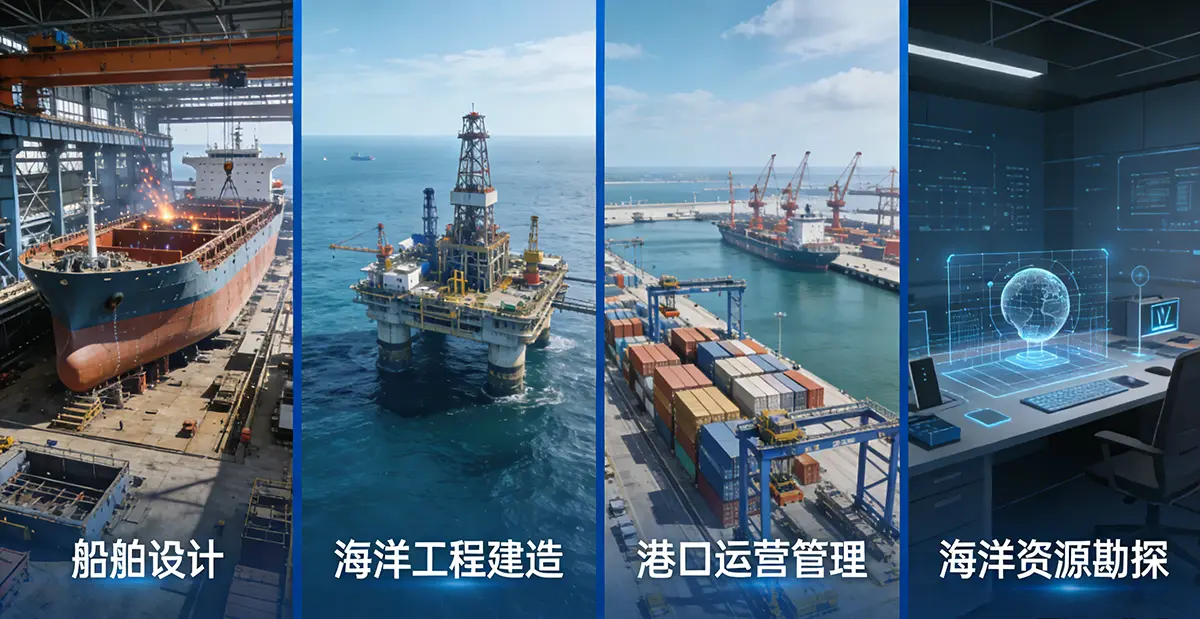
Introduction to the Naval Architecture and Ocean Engineering Major
Shipbuilding and Ocean Engineering is an engineering discipline that studies the design, construction, inspection, management, and maintenance of various vessels (such as transport ships, warships, and yachts) and marine structures (such as drilling platforms, offshore wind turbine foundations, and deep-sea exploration vehicles). It is an applied discipline that transforms fundamental sciences like theoretical mechanics, fluid mechanics, and structural mechanics into practical marine equipment.
If a maritime powerhouse is a blueprint, then Naval Architecture and Ocean Engineering is the brush that sketches and realizes that vision. This discipline extends beyond vessels themselves to encompass the development and utilization of marine resources, as well as the safeguarding of maritime rights and interests. It demands students possess a solid foundation in mathematics and mechanics, systematic engineering thinking, and the ability to solve complex engineering problems.
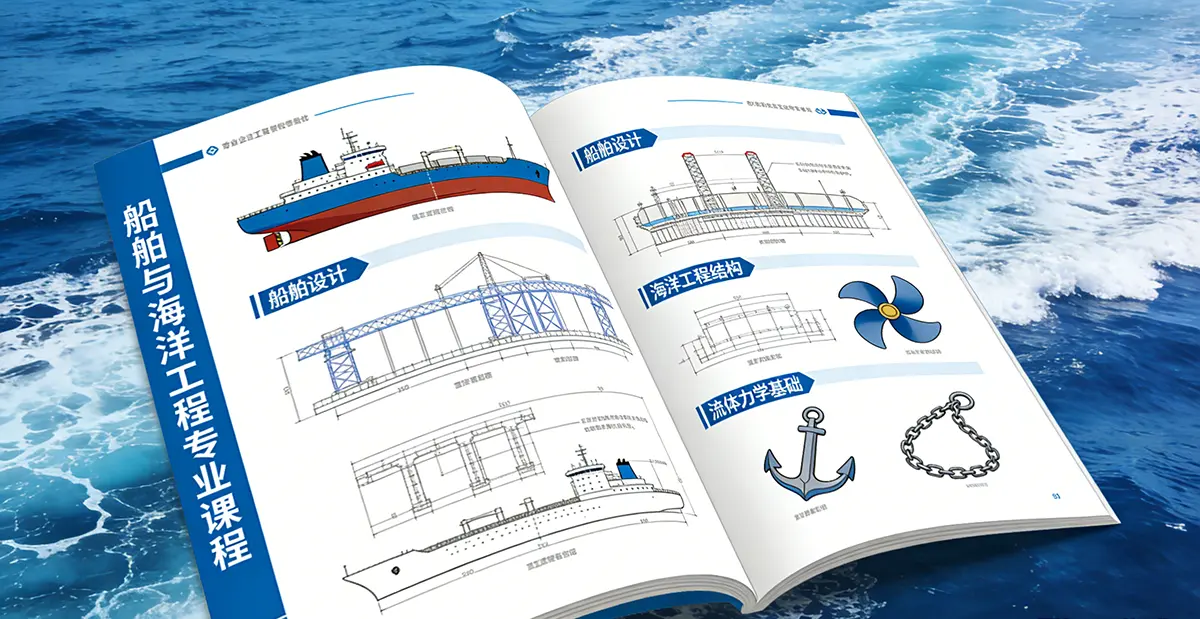
Core Curriculum in Naval Architecture and Ocean Engineering Major
The program's curriculum is built upon a robust mathematical foundation, a core mechanics framework, and extensive engineering practice.
Mathematics and Foundational Courses: Advanced Mathematics, Linear Algebra, Probability Theory and Mathematical Statistics, University Physics, Engineering Drawing, Engineering Materials and Welding, Electrical Engineering, Fundamentals of Programming.
Core Professional Courses (Mechanics as the Core):
- Fundamental Mechanics: Theoretical Mechanics, Mechanics of Materials
- Professional Mechanics: Ship Fluid Mechanics (or Fluid Mechanics for Naval Architecture and Ocean Engineering), Ship Structural Mechanics (or Structural Mechanics for Naval Architecture and Ocean Engineering)
- Ship Performance: Ship Statics, Ship Resistance and Propulsion, Ship Maneuverability and Seakeeping
Design and Construction Courses:
- Hull Structure and Drafting, Hull Strength and Structural Design
- Principles of Ship Design, Shipbuilding Technology
- Ship CAD/CAM (Computer-Aided Design/Manufacturing)
Practical Components: Metalworking Internship, Shipyard Internship, Shipboard Internship, Course Design, Graduation Project, etc.
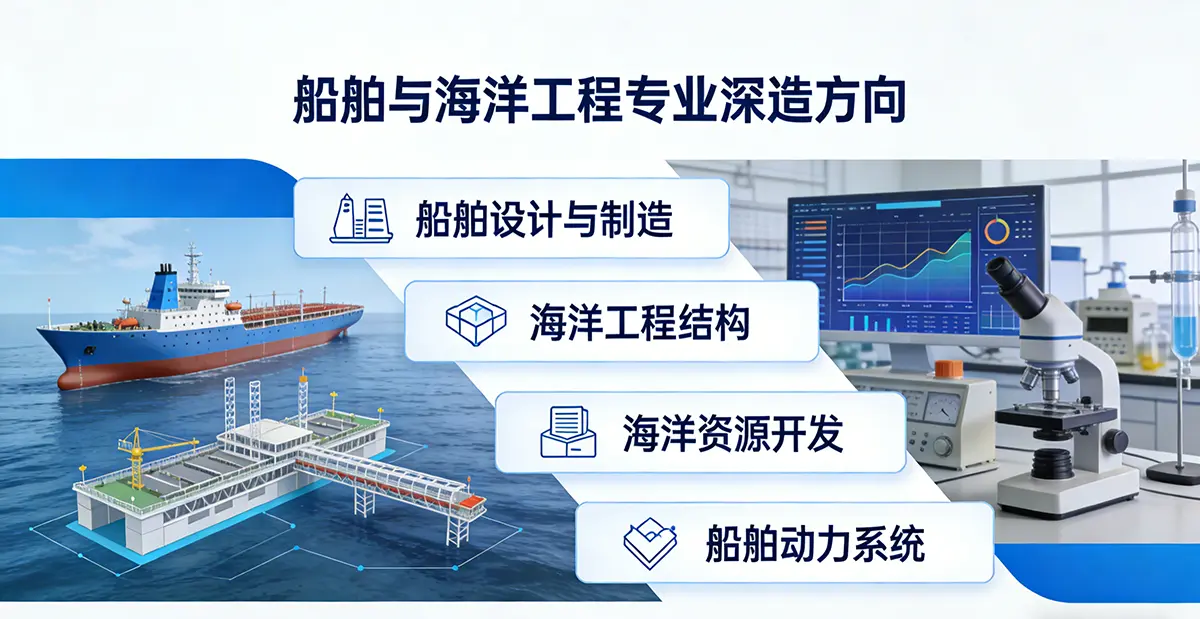
Advanced Study Pathways in Naval Architecture and Ocean Engineering Major
Pursuing graduate studies after undergraduate completion is the mainstream choice, especially with the strong demand for postgraduates under the “15th Five-Year Plan” emphasis on core technology breakthroughs. Research directions can be categorized into traditional fields and emerging frontiers:
Ship Design and Manufacturing: Ship design theory and methodology, digital shipbuilding and intelligent manufacturing, advanced ship manufacturing technologies, ship propulsion system design
Ship Mechanics (Core Foundations):
- Fluid Mechanics: Ship resistance and propulsion, seakeeping, maneuverability, computational fluid dynamics, cavitation flow
- Structural Mechanics: Structural Strength and Fatigue, Structural Optimization Design, Ultimate Strength, Composite Materials and Lightweight Structures
Offshore Engineering: Offshore Platform Design and Analysis, Deepwater Risers and Subsea Pipelines, Offshore Wind Turbine Foundations, Marine Renewable Energy Equipment
Underwater/Deep-sea Technology: Underwater Vehicle Design and Control, Submersibles and Deep-diving Technology, Deep-sea Space Stations, Underwater Operations Systems
Emerging Frontier Areas:
- Green Intelligent Ships: Clean Energy Vessels (LNG/Methanol/Ammonia/Hydrogen), Ship Energy Efficiency & Emission Control, Intelligent Ships & Autonomous Navigation
- Marine Equipment & Systems: Ship Vibration & Noise Reduction, Ship Safety, Ship Equipment & System Integration
- Polar Technology: Polar Ships & Icebreaking Technology, Polar Navigation Safety
Career Paths and Positions in Naval Architecture and Ocean Engineering Major
Graduates of Naval Architecture and Ocean Engineering enjoy broad employment prospects spanning the entire industry chain—from design and construction to inspection, operation, and management. Primary employment locations are concentrated in “Shenzhen” (20%), with the majority of positions falling under the “Machinery/Equipment/Heavy Industry” sector (21%).
Core Design and Construction Units (Primary Destinations)
- Positions: Ship Designer, Offshore Engineering Design Engineer, Construction Process Engineer, Production Manager
- Description: Employment opportunities exist at research institutes (e.g., 701, 702, 708 Institutes) and shipbuilding enterprises (e.g., Jiangnan Shipyard, Hudong-Zhonghua Shipbuilding, Waigaoqiao Shipbuilding) under China State Shipbuilding Corporation. Central state-owned enterprises offer stable employment and rapid technical growth.
Inspection/Certification/Maritime Administration
- Positions: Surveyor, Maritime Administration Civil Servant, Customs Administrator, Classification Society Inspector (CCS, Lloyd's Register, DNV, etc.)
- Description: Engage in ship inspection, maritime supervision, and statutory certification. Offers stable employment with high social recognition.
Shipping/Vessel Operations
- Positions: Shipbuilding Supervisor, Chief Engineer, Technical Manager at Ship Management Companies
- Description: Work in technical management and new ship construction supervision at shipping enterprises like COSCO Shipping and China Merchants Shipping.
Offshore Oil & Gas/New Energy
- Positions: Offshore Petroleum Engineer, Offshore Wind Power Engineer, Subsea Production Systems Engineer
- Description: Engaged in marine resource development at CNOOC, CNOOC Engineering, and offshore wind power developers.
Support Services/Trade/Finance
- Positions: Marine Equipment & Product Sales Engineer, Ship Finance Consultant, Marine Insurance Assessor
- Description: Serving in ship supply enterprises, bank ship financing departments, insurance companies, and ship trading companies.
Research & Education
- Positions: Researcher, University Professor, Laboratory Engineer
- Description: Pursuing advanced studies or engaging in research and teaching at universities and relevant institutes of the Chinese Academy of Sciences.
Representative Careers:
- Researcher at Ship & Offshore Engineering Design Institute
- Technical Manager at Ship Management Companies
- Management Personnel at Customs and Maritime Authorities
- Surveyor at Classification Societies
- Engineer at Offshore Oil Units
- Ship Finance and Insurance Assessor at Banks
- Management Personnel at Port Groups
- Engineer at Shipbuilding and Repairyards
Employment Rate and Industry Trends in Naval Architecture and Ocean Engineering Major
Employment Rate Data: The employment outlook for Naval Architecture and Ocean Engineering graduates remains strong. Among six ocean engineering disciplines, it ranks second, and among 278 engineering disciplines, it ranks 56th. At the 2026 Graduation Job Fair for Maritime Graduates hosted by Chongqing Jiaotong University's School of Shipping and Ship Engineering, 153 undergraduates secured on-the-spot employment contracts, accounting for approximately one-third of the graduating class. Over 40 renowned enterprises, including COSCO Shipping, Shandong Shipping, CCCC Dredging, and Fujian Shipbuilding Group, participated, offering more than 200 positions.
Salary Levels: Monthly compensation ranges from 4.5K to 50K RMB, with 44.5% of positions offering salaries between 8K and 15K RMB. Job openings in 2025 increased by 24% compared to 2024, reflecting robust market demand. By academic level, demand for master's degree holders accounted for 0.768% of the national master's pool, while demand for doctoral degree holders represented 0.154% of the national doctoral pool, indicating stable demand for high-end talent.
Industry Development Trends:
1. Strong National Strategic Impulse: The 15th Five-Year Plan (2026-2030) explicitly calls for “accelerating the development of a maritime power,” designating the shipbuilding industry as a key sector requiring “consolidation and enhancement.” China's shipbuilding sector is transitioning from scale leadership toward upgrading to the “high end of the value chain” and ensuring “security across the entire industrial chain.”
2. Green and Intelligent Transformation: Ship decarbonization has become imperative, with accelerated adoption of clean energy (methanol, ammonia, hydrogen) in marine applications. Intelligent vessels, autonomous navigation technologies, and AI-driven ship navigation systems are key R&D priorities. Liu Zuyuan, Chief Professor of Ship and Ocean Engineering at Wuhan University of Technology, highlighted at a ship engineering development strategy symposium that the field is undergoing a green and intelligent transformation.
3. High-End Equipment and Deep-Sea/Arctic Applications: High-value-added vessel types like deep-sea mining equipment, polar transport ships, LNG carriers, and large cruise liners are becoming R&D priorities. Strengthening support systems for deep-sea and polar exploration will drive demand for specialized vessels such as polar icebreakers, research ships, and deep-sea submersibles.
4. Rise of Modern Shipping Services: High-value-added service sectors like shipping finance, maritime arbitration, and ship brokerage will receive strong support.
5. Significant Talent Shortage: With few institutions offering programs, skilled professionals are highly sought after. By 2025, 118,862 job openings are projected, accounting for 0.456% of national vacancies.
Ideal Candidates for Naval Architecture and Ocean Engineering Major
If you possess the following traits, this major may be an excellent fit:
1. Strong foundation in physics and mathematics: Mechanics is the core of naval architecture and ocean engineering. The “four major mechanics”—theoretical mechanics, materials mechanics, fluid mechanics, and structural mechanics—underpin the entire discipline. Your mathematical foundation determines how deeply you can master mechanics.
2. Strong hands-on skills: Enjoy drafting, model-making, and metalworking labs, and are willing to gain practical experience at shipyards.
3. Excellent spatial visualization: Can comprehend and draw complex ship structure blueprints, imagining vessel forms in three-dimensional space.
4. Passion for the ocean: Curiosity about ships, naval vessels, offshore platforms, and deep-sea exploration, with a desire to contribute to maritime endeavors.
5. Rigorous attention to detail: Ship design impacts navigational safety and human lives, demanding exceptional responsibility and meticulous work ethic.
6. Physical endurance: Shipyard internships and sea trials may require physical stamina and adaptability to on-site working conditions.
Core Competencies of the Naval Architecture and Ocean Engineering Major
The core competitiveness of the Naval Architecture and Ocean Engineering program lies in its comprehensive system capabilities spanning from mechanical principles to engineering practice:
Mechanical Modeling and Analysis Capabilities: Ability to apply fluid mechanics and structural mechanics theories to establish mechanical models of naval vessels and offshore structures, analyzing their performance (resistance, propulsion, seakeeping, strength, etc.). This forms the foundation of the discipline.
Engineering Design and Drafting Capabilities: Mastery of hull structure and drafting, principles of ship design, and proficiency in using CAD/CAM software for designing marine structures.
Multidisciplinary System Integration Capabilities: Ability to synthesize knowledge from materials science, welding, propulsion, electrical systems, automation, and other disciplines to solve complex engineering problems in ship design, construction, and inspection.
Regulatory and Standards Application: Familiarity with construction regulations for marine structures and codes of major domestic and international classification societies. This is essential for inspection, classification, and maritime administration roles.
Practical Engineering Problem-Solving: Ability to propose innovative solutions for real-world challenges in shipbuilding and offshore development (e.g., vibration/noise reduction, corrosion resistance, polar navigation safety).
Ability to Integrate Cutting-Edge Technologies: Capable of integrating emerging technologies like AI, big data, and clean energy into naval architecture to develop innovative products such as smart ships and green vessels.
Leading Institutions Worldwide
Naval Architecture and Ocean Engineering maintains strong programs at top global engineering universities and specialized maritime institutions. Based on QS World University Subject Rankings and field reputation, leading institutions in this discipline include:(Selected Schools - Listed in no particular order)
| China | Tsinghua University | Global leader in large-scale shipbuilding and intelligent ship technology |
| Shanghai Jiao Tong University | Traditional powerhouse in naval architecture and ocean engineering, excelling in LNG carriers and deep-sea technology | |
| Harbin Engineering University | Distinctive focus on “Three Seas and One Nuclear” (shipbuilding, naval equipment, marine development, nuclear applications) | |
| Wuhan University of Technology | Strategic development research led by chief professors in naval architecture and ocean engineering | |
| Tianjin University | Distinctive strengths in offshore engineering and offshore wind power | |
| Dalian University of Technology | Strong capabilities in shipbuilding and coastal/offshore engineering | |
| Huazhong University of Science and Technology | Design and manufacturing of naval and offshore structures | |
| United States | Massachusetts Institute of Technology (MIT) | Global benchmark in marine engineering innovation and design, underwater vehicles, and AI-driven ship navigation |
| Netherlands | Delft University of Technology | World leader in ship and offshore structural design, dredging engineering, and sustainable shipping |
| Singapore | National University of Singapore | Strategic hub for deep-sea technology and marine logistics |
| Switzerland | ETH Zurich | Leading in marine science and marine environmental research |
| Other Strong Institutions | University of Cambridge, Imperial College London (fluid mechanics and marine structures), Norwegian University of Science and Technology (marine engineering, marine technology), University of Michigan, Ann Arbor (shipbuilding and marine engineering), Seoul National University, Pusan National University (leading shipbuilding nations), University of Tokyo, Osaka University, etc. | |
| China's Industry-Specific Institutions | Jiangsu University of Science and Technology (formerly East China Institute of Shipbuilding Industry), Jimei University (focusing on ship engineering and applied innovation), Bohai University (based in Bohai, serving nationwide), etc. | |
Recommended Learning Path for Naval Architecture and Ocean Engineering
Major
1. Build a Solid Foundation (Freshman and Sophomore Years):
Focus on mathematics and mechanics fundamentals. Master advanced calculus, theoretical mechanics, and materials mechanics—the cornerstones for all subsequent specialized courses. Simultaneously, become proficient in mechanical drafting and CAD software to develop spatial visualization skills. Begin familiarizing yourself with fundamental shipbuilding terminology from freshman year, such as “waterline” and “stability calculations.”
2. Build Your Professional Framework (Sophomore and Junior Years):
Delve into core courses including Fluid Mechanics, Structural Mechanics, Ship Statics, and Ship Resistance and Propulsion. Master design methodologies through courses like Hull Structure and Drafting, and Principles of Ship Design. Actively participate in practical sessions like metalworking workshops and shipyard internships to gain hands-on experience and understand actual production processes.
3. Focus and Deepen (Junior and Senior Years):
Based on personal interests (e.g., design, inspection, or research), select advanced electives such as Ship CAD/CAM, Ship and Ocean Engineering Management, and Ship Vibration and Noise Reduction. Aim to join a faculty research group and participate in specific projects (e.g., the “Undergraduate Innovation and Entrepreneurship Training Program”) to gain insight into the research process.
4. Future Planning (Throughout):
Graduate Studies: Pursuing a master's degree in Naval Architecture and Ocean Engineering is the mainstream choice, especially given the emphasis on core technology breakthroughs in the 15th Five-Year Plan. Monitor summer camps and graduate admissions information from top universities like Shanghai Jiao Tong University, Harbin Engineering University, and Tianjin University. Focus your graduate studies on cutting-edge fields like green intelligent ships and deep-sea technologies.
Direct Employment: Capitalize on the fall recruitment season by proactively monitoring job postings on the websites of state-owned enterprises like China State Shipbuilding Corporation, COSCO Shipping, and CNOOC, or attending campus career fairs. Employers prioritize practical experience; leverage winter and summer breaks for intensive internships while maintaining academic focus during the regular semester.
Certification Acquisition: Obtaining relevant certifications (e.g., Seafarer Competency Certificates, CAD proficiency certificates) enhances employability.
Embracing Cutting-Edge Fields: Self-study machine learning and clean energy technologies while tracking frontier areas like smart ships and green propulsion—key development priorities under the 15th Five-Year Plan.
Expanding Global Perspective: Pursue overseas exchange opportunities if feasible. Monitor international classification society standards and IMO regulatory updates to enhance English proficiency and global outlook.
- The Previous Passage:Materials Science and Engineering(Mater. Sci. Eng.)_材料科学与工程
- The Next Passage:Electrical Engineering(Electr. Eng.)_电机工程

Human Geography Major_Geography(Geog.)_人文地理
The Human Geography Major explores the complex relationships between human activities and space, cul···

Atmospheric Sciences(Atmos. Sci.)_大气科学
Atmospheric science is the study of phenomena and evolutionary patterns within Earth's atmospher···

Earth Sciences(Earth Sci.)_地球科学
The Earth Science major focuses on studying the Earth system and its interactions, providing a scien···

Ocean Sciences(Ocean Sci.)_海洋科学
PbootCMS是全新内核且永久开源免费的PHP企业网站开发建设管理系统,是一套高效、简洁、 强悍的可免费商用的···

