

Economics(Econ.)_经济学
Time:2026-03-08 Visits:8
Economics Major
The Economics Major is dedicated to studying the allocation of scarce resources and human choice behavior, utilizing rigorous modeling and data analysis to understand market mechanisms, policy effects, and macroeconomic trends. Its curriculum establishes a comprehensive theoretical framework from micro-level individuals to macro-level economies while strengthening econometric and data analysis skills, laying a solid foundation for students' career development in diverse fields such as finance, consulting, public policy, research, and technology. Exploring the Economics Major is the key pathway to mastering the analysis of complex social systems, driving business decisions, and participating in policymaking.

1. Introduction to the Economics Major
Economics is a social science discipline that studies the allocation of scarce resources. At its core, it analyzes how individuals, firms, and governments make choices, and how these choices determine the production, distribution, and consumption of goods and services. Through model-building and data analysis, it seeks to understand a wide range of issues including market functioning, economic cycles, international trade, public policy, poverty, and development. The Economics Major aims to cultivate talents equipped with logical reasoning, quantitative analysis, and problem-solving skills for complex real-world challenges. It serves not only as a foundation for business but also as the underlying logic for understanding the operations of modern society.
2. Major Courses in the Economics Major
| Module Category | Core Courses |
| Economic Theory Core | Microeconomics, Macroeconomics, Intermediate Microeconomics, Intermediate Macroeconomics, Political Economy |
| Mathematics & Quantitative Tools | Advanced Mathematics (Calculus, Linear Algebra), Probability Theory and Mathematical Statistics, Econometrics, Economic Data Processing and Analysis (Stata/R/Python) |
| Specialized Fields | Development Economics, International Economics, Monetary Economics and Finance, Public Economics, Labor Economics, Industrial Organization Theory, Behavioral Economics |
| Applied and Analytical Skills | Research Methods in Economics, Economic History, History of Economic Thought, Game Theory, Economics Paper Writing |
| Interdisciplinary and Frontier Studies | Environmental Economics, Health Economics, Digital Economics, Applications of Machine Learning in Economics |
3. Advanced Study Pathways for the Economics Major
Master's/PhD in Economics: The primary pathway to research positions in academia, high-level think tanks, or international organizations.
Master of Finance (MF), Financial Engineering: Transition into the finance industry for roles in quantitative analysis and investment research.
Master of Public Policy/Public Administration (MPP/MPA): Entry into government or non-profit organizations for policy analysis and formulation.
Master of Business Analytics/Data Science: Strengthening data analysis capabilities for careers in the technology or consulting industries.
Juris Doctor (JD): Combining an economics background with specializations in antitrust, financial regulation, intellectual property law, etc.
Master of Business Administration (MBA): Developing comprehensive management skills, with the economics background providing a unique strategic perspective.
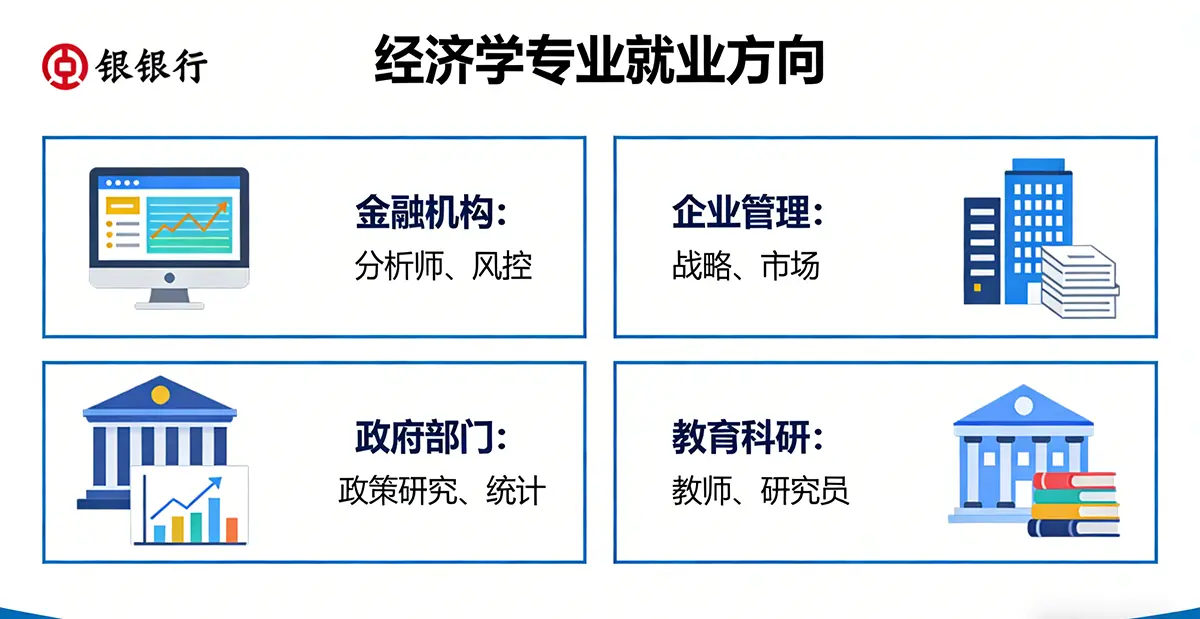
4. Career Paths and Positions for the Economics Major
Economics is often called the “crown jewel of the social sciences,” offering a vast array of career opportunities. However, competition for top-tier positions is intense and heavily reliant on institutional reputation, quantitative skills, and internship experience.
Finance Industry
Investment Banks/Securities Firms: Industry Researcher, Macroeconomic Analyst, Investment Banking Analyst.
Commercial Banks: Credit Analyst, Risk Management Specialist, Financial Markets Trader.
Private Equity/Venture Capital/Hedge Funds: Investment Analyst (typically requiring top-tier academic credentials or experience).
Insurance Companies/Asset Management Firms: Asset Allocation Specialist, Credit Assessment Analyst.
Consulting and Professional Services
Management Consulting Firms (e.g., McKinsey, BCG, Bain): Business Analyst/Consultant, providing strategic advice to corporations.
Economic Consulting Firms: Specializing in economic analysis for antitrust cases, commercial litigation, and policy evaluation.
Public Sector and International Organizations
Government Agencies: Economic Analyst and Policy Researcher at central banks (monetary policy research), ministries of finance, development and reform commissions, and statistics bureaus.
International Organizations: Research or Program Officer at institutions like the World Bank, International Monetary Fund (IMF), and Organisation for Economic Co-operation and Development (OECD).
Technology and Internet Companies
Strategy/Business Analysis Departments: Market Analysis, Competitive Strategy, User Behavioral Economics Analysis.
Data Scientist (requires strong quantitative skills): Conducting business analysis using economic causal inference methods.
Research Institutions and Think Tanks
Researcher at universities, academies of social sciences, development research centers, etc. (typically requires a doctoral degree).
5. Employment Rate and Industry Trends for the Economics Major
Employment Rate Characteristics
“Broad Scope, High Divergence”: Overall employment rates are generally acceptable, but job quality shows severe polarization. Students from top-tier institutions with strong quantitative backgrounds secure positions in high-paying industries, while those with ordinary backgrounds face fierce competition.
“Tool-Oriented” Trend is Evident: Pure theoretical economics offers limited career prospects; proficiency in econometrics and data analysis tools (Stata/R/Python) is essential currency in the job market.
High Proportion Pursuing Advanced Studies: Particularly at first-class universities, a large number of undergraduates choose to pursue master's degrees (especially in finance, economics, or public policy) to enhance their competitiveness.
Industry Development Trends
Deep Integration of Data Science and Economics: Causal Inference Revolution: Microeconometric methods like Randomized Controlled Trials (RCTs) and Difference-in-Differences (DID) have become standard in technology companies (A/B testing) and policy evaluation. Big Data and Machine Learning Applications: Utilizing massive unstructured data (e.g., satellite imagery, search data) for economic forecasting and market analysis.
Commercial Applications of Behavioral and Experimental Economics: The application of “nudge” theory in product design, marketing strategies, and public policy has created roles related to “behavioral insights.”
Rise of Environmental, Social, and Governance (ESG) Economics: Topics like carbon pricing, green finance, and ESG investing have become hotspots, requiring economic expertise for cost-benefit analysis and policy design.
Platform Economy and Digital Governance: Competition policy (antitrust), data property rights, and tax rule-making in digital markets demand in-depth economic analysis.
Reshaping of Global Supply Chains and Economic Security: Geopolitical changes are driving demand for economic research on global trade, industrial chain resilience, and security of critical materials.

6. Leading Global Institutions for the Economics Major
Economics is a core foundational discipline at comprehensive universities, with numerous top-tier departments worldwide.(Selected Schools - Listed in no particular order)
Country/Region | Representative Institutions (Leading Economics Programs)
United States | University of Chicago (a hub of modern economics), Harvard University, Massachusetts Institute of Technology (MIT), Stanford University, Princeton University, University of California, Berkeley
United Kingdom | London School of Economics and Political Science (LSE), University of Cambridge, University of Oxford, University of Warwick
Europe | Barcelona School of Economics (Spain), Tilburg University (Netherlands), Toulouse School of Economics (France)
Asia | National University of Singapore, Peking University (China Center for Economic Research), Tsinghua University (School of Economics and Management), Renmin University of China (School of Economics)
Other | University of Toronto (Canada), Australian National University
7. DisciplineMajor Recommendations
Ideal Candidates for the Economics Major
Individuals with a strong curiosity and desire to explore the principles of social operation, the motivations behind human behavior, and public policy.
Those who possess excellent logical thinking, abstract reasoning, and mathematical abilities.
Individuals who enjoy using data and models to verify ideas and explain the world, not content with vague discussions.
Those aspiring to have a profound impact in business, policy, or academia.
Core Competencies of the Economics Major
Rigorous logical reasoning and economic modeling capabilities.
Solid foundation in econometrics and data processing skills (able to use data to tell a compelling causal story).
Acute insight into real-world economic issues and critical thinking.
Excellent writing and communication skills to clearly present complex economic analysis to diverse audiences.
Study Recommendations for the Economics Major
Prioritize Mathematics and Econometrics: Devote the most effort to mastering these subjects, as they are key to distinguishing an average from an outstanding economics graduate.
Learn Programming and Data Analysis Early: Master Python or R and become proficient in using Stata.
Accumulate High-Quality Internships: Strive for internships at securities firm research institutes, consulting companies, think tanks, or government research departments.
Participate in Research Projects or Assistantships: Conduct research under professors and attempt to write academic papers, which is crucial for advanced studies.
Read Extensively and Think Critically: Follow *The Economist*, mainstream financial media, and top academic journals to cultivate economic intuition.
Define Your Career Path Early: Clarify as soon as possible whether to pursue an academic, finance, consulting, or policy path, and build targeted skills and networks accordingly.
*Note: Some institutions may categorize this major under different disciplines. Please refer to the specific classification used by the institution.*
- The Previous Passage:Chinese(Chinese Studies 或 Sinology (汉学))_汉语
- The Next Passage:Japanese(Japanese Studies)_日语
Human Geography Major_Geography(Geog.)_人文地理
The Human Geography Major explores the complex relationships between human activities and space, cul···

Atmospheric Sciences(Atmos. Sci.)_大气科学
Atmospheric science is the study of phenomena and evolutionary patterns within Earth's atmospher···
Earth Sciences(Earth Sci.)_地球科学
The Earth Science major focuses on studying the Earth system and its interactions, providing a scien···
Ocean Sciences(Ocean Sci.)_海洋科学
PbootCMS是全新内核且永久开源免费的PHP企业网站开发建设管理系统,是一套高效、简洁、 强悍的可免费商用的···

