

Mathematics and Statistics(Math & Stats)_数学与统计
Time:2026-07-02 Visits:0
Mathematics and Statistics Major
The Mathematics and Statistics Major is a foundational scientific discipline studying quantity, structure, space, and uncertainty, providing the universal language and core tools for modern technology. It cultivates rigorous logical thinking, abstract modeling, and precise data analysis skills, forming the cornerstone for entering high-tech fields like fintech, data science, and AI. This article details its core curriculum, diverse advanced pathways, broad career prospects, and leading global institutions.
1. Introduction to the Mathematics and Statistics Major
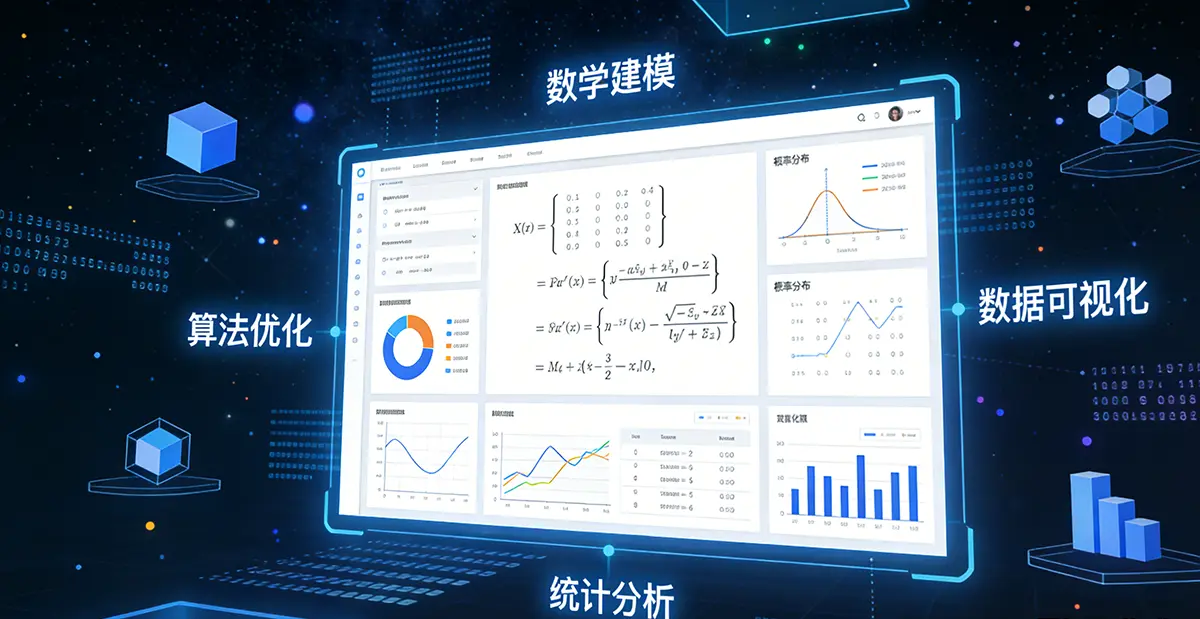
The Mathematics and Statistics Major is a foundational scientific discipline dedicated to the study of quantity, structure, space, and uncertainty. It also serves as the universal language and essential toolkit for modern science and technology. Mathematics focuses on abstract concepts, logical reasoning, and deterministic models, while Statistics concentrates on data collection, analysis, and probabilistic inference to address real-world uncertainties. This major cultivates rigorous logical thinking, powerful abstract modeling capabilities, and precise data analysis skills, establishing the foundational cornerstone for entry into numerous high-tech and cutting-edge fields.
2. Core Curriculum of the Mathematics and Statistics Major
| Module Category | Core Courses |
| Mathematics Core | Mathematical Analysis/Advanced Calculus, Advanced Algebra/Abstract Algebra, Analytic Geometry, Complex Analysis, Ordinary Differential Equations, Partial Differential Equations, Real Analysis & Functional Analysis (Advanced), Topology (Advanced) |
| Statistics Core | Probability Theory, Mathematical Statistics, Regression Analysis, Multivariate Statistical Analysis, Time Series Analysis, Stochastic Processes, Bayesian Statistics, Nonparametric Statistics, Statistical Computing |
| Computation & Tools | Numerical Analysis, Mathematical Modeling, Introduction to Algorithms, Data Structures, Programming Languages (Python/R/C++), Scientific Computing Software (MATLAB) |
| Interdisciplinary Applications (Electives) | Financial Mathematics, Biostatistics, Actuarial Models, Machine Learning Theory, Optimization Theory, Operations Research |
3. Advanced Study Pathways for the Mathematics and Statistics Major
Graduates of the Mathematics and Statistics Major commonly pursue Master's or PhD degrees in Pure/Applied Mathematics or Statistics for careers in academia, university teaching, or advanced R&D. The major also provides an exceptional foundation for interdisciplinary advanced study. Popular pathways include Data Science/Business Analytics, Financial Engineering/Quantitative Finance, Computer Science/AI (strengthening algorithmic foundations), Biostatistics/Epidemiology, and Operations Research/Industrial Engineering. Additionally, graduates can obtain teaching credentials to pursue careers as mathematics teachers in secondary or international schools.

4. Career Paths for Mathematics and Statistics Major
Armed with powerful quantitative logic and modeling skills, graduates of the Mathematics and Statistics Major can enter virtually any industry requiring deep analytical capabilities. High-salary destinations in Finance and Technology include roles as quantitative researchers, data scientists, machine learning engineers, and algorithm engineers. In Traditional Industries and R&D, graduates become industrial statisticians, biostatisticians, quality engineers, or researchers in government agencies. The Mathematics and Statistics Major also leads to careers in Education and Basic Services as teachers, lecturers, or statistical analysts in sectors like insurance and market research.
5. Employment and Industry Trends for the Mathematics and Statistics Major
Employment is characterized by “strong foundational training and broad applicability.” While not tied to a specific job title, the major’s powerful transferable skills ensure wide, long-term career adaptability. Salary potential varies, with graduates from top programs possessing strong programming skills commanding high starting salaries in finance and tech, while other roles offer moderate entry-level pay. A high proportion pursue advanced degrees to specialize.
Key industry trends driving demand for Mathematics and Statistics Majors include: the rise of Data Science as a core career path across all sectors; the essential role of mathematical theory (optimization, linear algebra, probability) as the foundation of Artificial Intelligence; the deepening complexity and opportunities in Quantitative Finance; the increasing digitalization of scientific research reliant on modeling and analysis; and the growing importance of mathematical theory in data privacy and security.

6. Leading Global Institutions Offering the Mathematics and Statistics Major
(Selected Institutions - Ranking Not in Order)Mathematics and Statistics are core foundational disciplines in comprehensive universities worldwide, with top institutions hosting prestigious and powerful departments dedicated to this major.
| Country/Region | Representative Institutions (Leading in Mathematics & Statistics) |
| United States | Princeton University, Massachusetts Institute of Technology (MIT), Stanford University, Harvard University, University of California, Berkeley, University of Chicago |
| United Kingdom | University of Cambridge, University of Oxford, Imperial College London, University of Warwick (top in Statistics) |
| Europe | École Normale Supérieure (Paris, France), ETH Zurich (Switzerland), University of Bonn (Germany) |
| Asia | National University of Singapore (NUS), Peking University, Tsinghua University, University of Tokyo |
| Other | University of Waterloo (Canada, strong in Applied Math & CS), Australian National University (ANU) |
DisciplineMajor Recommendations
Ideal Candidates for the Mathematics and Statistics Major:
This major is ideal for individuals who love abstract thinking, possess exceptionally rigorous logic, and enjoy the process of solving complex intellectual puzzles. They have a deep curiosity about the underlying mathematical principles governing the world and demonstrate exceptional patience, focus, and resilience in the face of challenging problems.
Core Competencies of the Mathematics and Statistics Major:
The Mathematics and Statistics Major builds rigorous logical reasoning and proof skills, a fundamental distinction from general data analysts. It develops deep abstract modeling ability to translate real-world problems into mathematical or statistical frameworks. Graduates gain strong computational and algorithmic implementation skills to operationalize theoretical models through programming. The program also fosters rapid learning and knowledge transferability, enabling graduates to quickly adapt to new domains and establish their quantitative frameworks.
Learning Recommendations for Mathematics and Statistics Majors:
Treat the combination of “Mathematics/Statistics + Programming + Domain Knowledge” as the golden triad, with each component being indispensable. Learn programming languages like Python/R and data structures early. Actively participate in mathematical modeling competitions (e.g., MCM/ICM) to demonstrate applied skills. Identify your application focus through internships or projects in fields like finance, tech, or biology, and pursue targeted learning accordingly. Build a solid foundation in theoretical proofs without limiting yourself to theory alone—master both the “why” and the “how to apply.” Proactively engage with core quantitative courses in cutting-edge interdisciplinary fields such as machine learning and quantitative finance.
*Note: Program classification may vary by institution; always verify the specific structure at your chosen university.*
- The Previous Passage:Marketing(Mktg)_市场营销
- The Next Passage:没有了!
Human Geography Major_Geography(Geog.)_人文地理
The Human Geography Major explores the complex relationships between human activities and space, cul···

Atmospheric Sciences(Atmos. Sci.)_大气科学
Atmospheric science is the study of phenomena and evolutionary patterns within Earth's atmospher···

Earth Sciences(Earth Sci.)_地球科学
The Earth Science major focuses on studying the Earth system and its interactions, providing a scien···

Ship and Ocean Engineering(Ship Ocean Eng.)_船舶与海洋工程
Naval Architecture and Ocean EngineeringNaval Architecture and Ocean Engineering is a core engineeri···

