

Public Administration(Pub. Admin.)_公共管理
Time:2026-03-08 Visits:2
Public Administration Major
The Public Administration Major is dedicated to cultivating professionals in public service and management, focusing on government operations, policy analysis, and public governance. Its curriculum encompasses management theory, the policy process, public finance, and governance skills, providing students with a comprehensive knowledge base and practical abilities for careers in government agencies, public utilities, non-profit organizations, and policy consulting. Choosing the Public Administration Major is a significant first step towards enhancing public value, promoting good governance, and achieving effective administration.

1. Introduction to the Public Administration Major
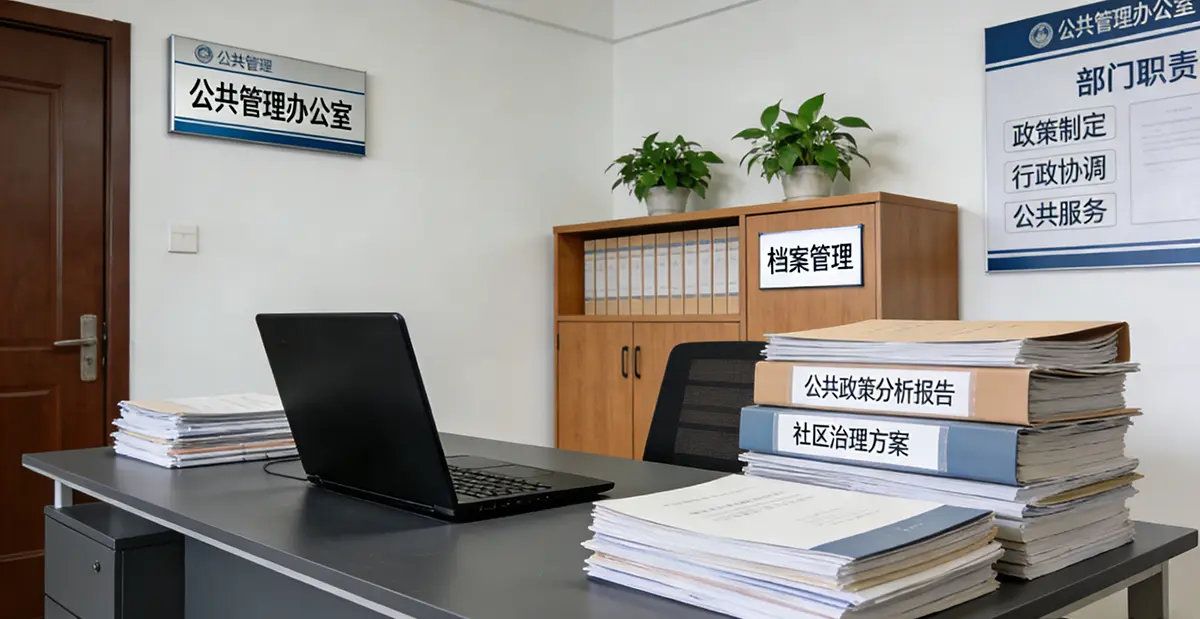
Public Administration is an applied social science discipline that studies how to effectively manage public sectors, non-profit organizations, and public policies to serve the public interest. It focuses on the operations of government and public organizations, the formulation and implementation of public policies, public finance and budgeting, the delivery of public services, and human resource management within the public sector. This major aims to cultivate professionals equipped with a spirit of public service, management capabilities, and policy analysis skills, serving as a core discipline for enhancing government governance efficacy and advancing good social governance.
2. Core Curriculum of the Public Administration Major (Table)
| Module Category | Core Courses |
| Theoretical Foundations | Public Administration, Public Policy Analysis, Principles of Political Science, Public Economics, Organizational Behavior |
| Core Management Skills | Public Sector Human Resource Management, Public Finance and Budgeting, Public Sector Performance Management, Public Sector Strategic Management |
| Policy and Governance | Policy Process and Evaluation, Public Ethics and Accountability, Local Government Management, Comparative Public Administration, Digital Governance |
| Quantitative and Qualitative Methods | Social Science Research Methods, Public Administration Statistics, Cost-Benefit Analysis, Case Study Methods |
| Law and Institutions | Administrative Law and Administrative Litigation Law, Public Sector Contract Law, Government and Nonprofit Organization Accounting |
| Professional Practice | Leadership Development, Public Sector Project Management, Crisis Management, Public Negotiation and Communication |
3. Advanced Study Pathways for the Public Administration Major
Master of Public Administration (MPA)/Master of Public Policy (MPP): These are specialized advanced degrees that serve as key credentials for entry into mid-to-senior level public management positions.
Doctor of Philosophy (Ph.D.) in Public Administration/Political Science: For pursuing academic research or joining high-level policy research institutions.
Master of Laws (LL.M.): Focusing on areas like administrative law or constitutional law to prepare for roles as government legal counsel.
Master of Social Work (MSW): Directing career development towards community service and non-profit organization management.
Master of Business Administration (MBA): Broadening business management knowledge, applicable in fields involving government-business collaboration.
Master of International Development/Public Health: Leading to careers in international organizations or public health administration departments.

4. Career Paths and Positions for the Public Administration Major
Employment is primarily distributed across government, public utilities, non-profit organizations, and related supporting sectors.
Government Departments (Core Destination)
Administrative Agencies at Various Levels: Entering departments such as the National Development and Reform Commission, Ministry of Finance, Ministry of Human Resources and Social Security, Ministry of Civil Affairs, and National Health Commission through civil service examinations for roles in policy research, general administration, human resources, or finance.
Local Governments and Grassroots Units: General administration and community governance positions in sub-district offices and township governments.
Public Utilities and State-Owned Enterprises
Public Institutions (e.g., universities, hospitals, research institutes): Administrative management personnel, Party committee office staff.
Public Utility Companies (water, electricity, gas, public transportation): Public affairs management, government relations, compliance management positions.
Policy Banks and Large State-Owned Enterprises: Strategic planning, Party and mass organization work, corporate social responsibility departments.
Non-Profit Organizations and International Institutions
Foundations, Industry Associations, Social Service Agencies: Project managers, operations supervisors, fundraising specialists.
China-based offices or overseas projects of International Organizations: Project assistants, policy researchers.
Consulting and Think Tanks
Public Administration/Policy Consulting Firms: Consultants providing performance evaluation, process optimization, and policy advisory services to governments.
Think Tanks and Research Institutions: Policy analysts, researchers.
Private Sector
Corporate Public Affairs/Government Relations Departments: Responsible for government communication, policy interpretation, and compliance.
5. Employment Rate and Industry Trends for the Public Administration Major
Employment Rate Characteristics
“Stable Demand, Structured Competition”: Employment demand in the public sector is stable, but access requires navigating structured competition through civil service and public institution examinations. Exam preparation is thus a crucial extension of the academic studies in this major.
“Equal Emphasis on Experience and Seniority”: Advancement in public administration positions typically values grassroots experience, practical management skills, and policy comprehension, with career progression following a well-defined hierarchical system.
“Significant Regional Variations”: Competition for public sector positions in economically developed regions and major cities is intense, but these roles offer greater platforms and development opportunities.
“Moderate Starting Salaries with Comprehensive Benefits”: Starting salaries in the public sector are generally not as high as in some lucrative industries but offer high job stability and a well-established benefits system.
Industry Development Trends
Government Digital Transformation and Smart Governance: Initiatives like “Internet Plus Government Services,” data sharing, and “city brain” projects require public administrators to possess digital literacy and data-driven decision-making capabilities.
Precision in Public Services and Social Governance Innovation: The shift from extensive management to refined, personalized services is driving model innovation in areas such as community governance, elderly care, and childcare.
Performance Management: Shifting from “Process-Oriented” to “Outcome-Oriented”: Strengthening performance evaluation of public projects and cost-benefit analysis to improve the efficiency of fiscal fund utilization and the quality of public services.
Normalization of Crisis Management and Resilience Building: Following emergencies like pandemics, emergency management systems, public health governance, and social risk early warning have become core issues in public administration.
Cross-Departmental Collaboration and “Whole-of-Government” Development: Breaking down departmental barriers to promote horizontal and vertical coordination in policy formulation and implementation, addressing complex public problems.
Development of Non-Profit Organizations and Public-Private Partnership Models: The growth of government-purchased services and PPP models demands professionals who understand both public value and project management.
6. Leading Global Institutions for the Public Administration Major
Master of Public Administration (MPA) programs serve as a global benchmark for cultivating talent for the public sector.
Country/Region | Representative Institutions (Top Public Administration/Public Policy Schools)
United States | Harvard University (Kennedy School of Government), Syracuse University (Maxwell School of Citizenship and Public Affairs), University of California, Berkeley (Richard & Rhoda Goldman School of Public Policy), Princeton University
United Kingdom | University of Oxford (Blavatnik School of Government), London School of Economics and Political Science (LSE), University College London (UCL)
Singapore | National University of Singapore (Lee Kuan Yew School of Public Policy)
Europe | Erasmus University Rotterdam (Netherlands), Sciences Po Paris (France)
China | Tsinghua University (School of Public Policy and Management), Peking University (School of Government), Renmin University of China (School of Public Administration), Shanghai Jiao Tong University (School of International and Public Affairs)
Other | University of Toronto (Canada), Australian National University
7. DisciplineMajor Recommendations
Ideal Candidates for the Public Administration Major
Individuals passionate about public affairs, possessing a sense of responsibility and mission to serve society.
Those with strong organizational and coordination skills, communication abilities, and a pragmatic spirit for solving complex problems.
Adaptable to institutionalized, procedural work environments while also possessing innovative thinking.
Those concerned with social equity, policy effectiveness, and the improvement of people's livelihoods.
Core Competencies of the Public Administration Major
The ability to understand the operational logic and political dynamics of the public sector.
Skills in policy analysis, program design, and evaluation.
The capacity to manage and optimize public resources (human and financial).
The ability to communicate, negotiate, and build consensus with diverse stakeholders.
Study Recommendations for the Public Administration Major
Begin preparing for civil service examinations early: Integrate professional studies with exam content such as the Administrative Aptitude Test and Essay Writing.
Accumulate internship experience in the public sector: Strive for internships in government agencies, public institutions, or large non-profit organizations.
Strengthen quantitative analysis skills: Study statistics and data visualization to adapt to the trends of performance management and evidence-based decision-making.
Develop writing and reporting capabilities: Policy briefs, research reports, and official document drafting are essential for daily work.
Stay informed about national policies and local reform pilots: Understand the policy context to cultivate policy acumen.
Build a cross-disciplinary knowledge base: Proactively learn about related fields such as economics, law, and sociology.
*Note: Some institutions may categorize this major under different disciplines. Please refer to the specific classification used by the institution.*
- The Previous Passage:Translation and Interpreting(Translation Studies 或 Interpreting Studies)_翻译
- The Next Passage:Communication Studies(Comm. Stud.)_沟通学

Human Geography Major_Geography(Geog.)_人文地理
The Human Geography Major explores the complex relationships between human activities and space, cul···

Atmospheric Sciences(Atmos. Sci.)_大气科学
Atmospheric science is the study of phenomena and evolutionary patterns within Earth's atmospher···

Earth Sciences(Earth Sci.)_地球科学
The Earth Science major focuses on studying the Earth system and its interactions, providing a scien···

Ocean Sciences(Ocean Sci.)_海洋科学
PbootCMS是全新内核且永久开源免费的PHP企业网站开发建设管理系统,是一套高效、简洁、 强悍的可免费商用的···

