

Musicology(Musicology)_音乐学
Time:2026-08-19 Visits:1
Musicology (Performance and Composition) Major
The Musicology (Performance and Composition) Major bridges music scholarship with artistic practice. Explore its curriculum in history, analysis, performance, and composition, alongside unique career paths as scholar-performers, educators, and creatives in academia and the arts.
1. Introduction to the Musicology (Performance and Composition) Major
The Musicology (Performance and Composition) Major is an interdisciplinary, applied discipline established to deeply integrate performance practice and composition/arrangement upon a solid foundation of musicological scholarship. It aims to dismantle the barriers between theory and practice, cultivating a new generation of versatile professionals adept at both rigorous academic research and high-level artistic practice. Graduates of this major not only master theoretical tools such as music history, analysis, and aesthetics but also possess the ability to translate academic insights into tangible artistic expression through performance or composition. They can also generate novel research questions from their artistic endeavors. This major is designed for music students who are passionate about critical thinking as well as the stage and the creative process, and who resist being confined to a single professional identity.
2. Core Curriculum of the Musicology (Performance and Composition) Major
| Module Category | Core Courses |
| Foundations of Musicological Theory | Western Music History (Period and Thematic Studies), Chinese Music History/Ethnomusicology, Music Aesthetics, Music Analysis (Form, Harmony, Counterpoint), Musicological Methodology, Academic Writing |
| Core Performance/Composition Practice | Primary Instrument/Voice (one-on-one, requiring advanced proficiency), Composition/Arrangement Major, Chamber Music/Ensemble, Sight-Reading of New Works |
| Composition and Theory Integration | Work Analysis (with compositional perspective), Stylistic Imitation Writing, 20th-21st Century Composition Techniques, Music and Text (Art Song, Opera Studies) |
| Integration of Research and Practice | Performance Practice Research, Music Editing and Score Studies, Field Research and Recording Practice, Individual Research/Creative Project |
| Electives and Skill Development | Second Instrument, Conducting Fundamentals, Digital Audio Workstation Applications, World Music Cultures, Introduction to Music Psychology |
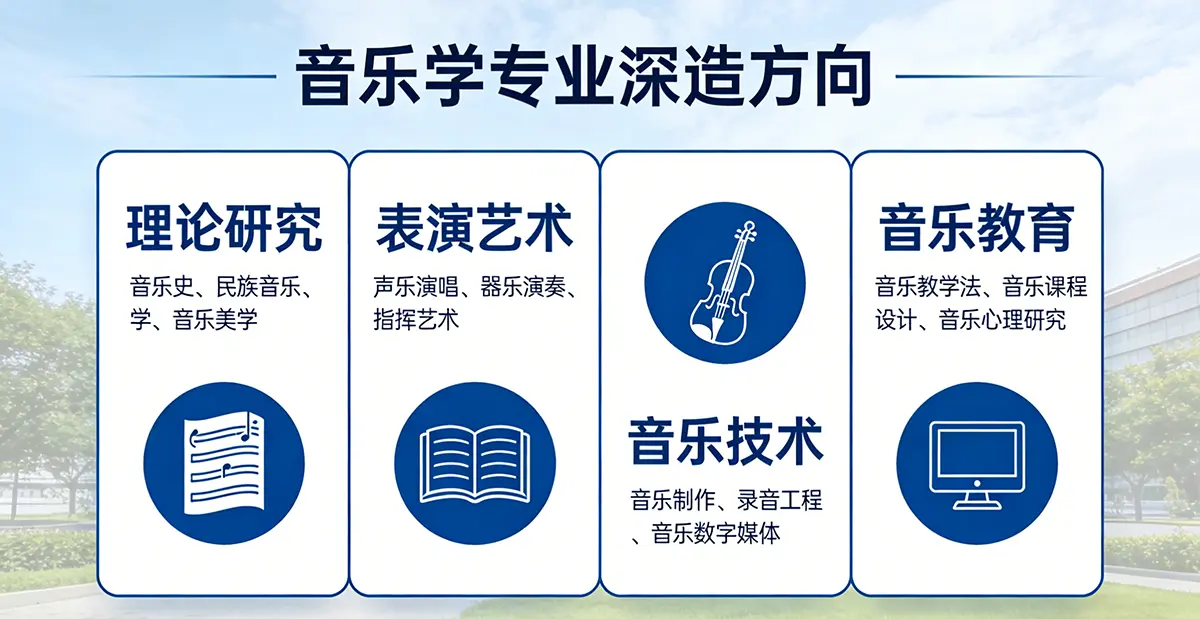
3. Advanced Study Pathways for the Musicology (Performance and Composition) Major
Master’s/PhD in Musicology: Specialize in areas like performance practice research, historical performance, or composer studies, pursuing an academic research career.
Master’s/PhD in Composition/Compositional Theory: Deepen creative expertise, focusing on specific contemporary techniques or research areas.
Master’s/Artist Diploma in Performance: Further elevate instrumental/vocal proficiency towards a professional performance career.
Master’s in Music Theory: Concentrate on theoretical research in music analysis, harmony, etc.
Master’s in Arts Administration/Cultural Policy: Transition to management or policy roles within music organizations.
Master’s in Music Therapy (requires additional coursework): Combine music practice with psychology.
Master’s in Interdisciplinary Studies (e.g., Sound Studies, Digital Humanities).
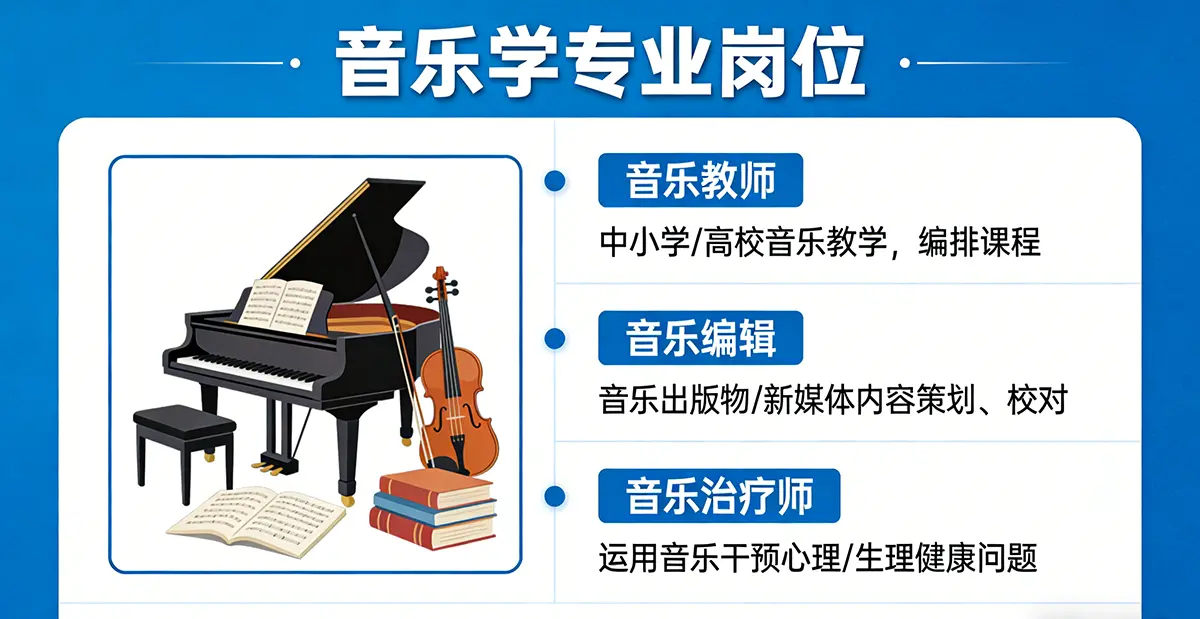
4. Career Paths and Positions for Musicology (Performance and Composition) Graduates
| Sector | Typical Positions | Primary Responsibilities and Skill Application |
| Education & Research | University/Conservatory Faculty | Teach theoretical courses (e.g., history, analysis) and potentially guide performance/composition practice. |
| Research Institute Assistant Researcher | Participate in music research projects: data collection, paper writing, and artistic validation. | |
| Artistic Creation & Performance | Freelance Musician/Composer | Host lecture-recitals or accept commissions, leveraging scholarly background for depth. |
| Theater/Orchestra Music Research/Literary Dept. Specialist | Provide scholarly support for productions, write in-depth program notes, assist in repertoire planning. | |
| Historical Instrument/Historically Informed Practice Ensemble Performer | Perform professionally using research on period instruments and practices. | |
| Cultural Institutions & Media | Publishing House Music Book/Score Editor | Review, edit, and plan publications of scholarly works and performance editions. |
| Music Magazine/New Media Critic & Editor | Write reviews and interviews blending academic rigor with accessibility. | |
| Museum/Archive Music Curator or Researcher | Conduct research on musical artifacts, curate exhibitions, develop public programs. | |
| Cultural Industries & Emerging Fields | Cultural Tourism/Performing Arts Project Content Consultant | Provide scholarly guidance on historical, stylistic, and musical content for projects. |
| Music Technology Company Content Strategist | Design curriculum or interactive experiences grounded in musicological research. | |
| Arts Foundation Project Evaluation Specialist | Assess grant applications with scholarly discernment and manage funded projects. | |
| Public Service | Cultural Bureau/Intangible Heritage Center Commissioner | Engage in policy research for traditional music investigation, preservation, and revitalization. |
5. Employment Rates and Industry Trends for the Musicology (Performance and Composition) Major
Employment Rate Characteristics:
“A Niche, Elite Pathway with Relative Balance”: The program has clear objectives and a limited output of graduates. The most suitable roles (university faculty, research institutes, high-end cultural organizations) require advanced degrees and outstanding scholarly achievements, leading to intense yet focused competition.
“Interdisciplinary Competence is the Core Advantage”: Candidates who can both teach theoretical courses and guide practical work hold a significant edge for academic positions. In the arts market, artists or curators with scholarly credentials offer unique value.
“Career Development is ‘Slow-Burn’ and ‘Long-Term’”: Both academic reputation and artistic recognition require time to build. Initial stages may present challenges, but prospects broaden with sustained output.
“Freelance and Project-Based Work are Common”: Particularly in artistic practice and consulting, strong project development and management skills are essential.
Industry Trends:
“Research-Led Performance” and “Practice-Based Research” as Frontiers: Academia increasingly values performance as a research method and output format, while the arts sector prioritizes scholarly depth and historical accuracy in projects.
Interdisciplinary and Technological Convergence: Integrating musicology with digital humanities, AI, and cognitive science opens new possibilities in analysis, stylistic simulation, and historical performance reconstruction.
Intangible Cultural Heritage Preservation and Creative Transformation: Research, documentation, and modern creative work based on traditional music receive significant attention from both state and market sectors.
Deepening Demand for Public Music Education: The market needs more high-quality educational content that seamlessly integrates historical context, cultural background, and live performance.
Professional Support in Cultural IP Development: Film, gaming, and cultural tourism projects increasingly demand accuracy in historical or ethnic music content, creating demand for expert consultants.
6. Major Global Institutions Offering the Musicology (Performance and Composition) Major
| Country/Region | Representative Institutions (Leading in Musicology/Practice-Integrated Programs) |
| United States | Yale School of Music, Eastman School of Music (University of Rochester), Princeton University, Stanford University |
| United Kingdom | University of Cambridge, University of Oxford, King’s College London, Royal Academy of Music |
| Continental Europe | Berlin University of the Arts, École Normale Supérieure de Paris, University of Music and Performing Arts Vienna |
| China | Central Conservatory of Music, Shanghai Conservatory of Music, Graduate School of Chinese National Academy of Arts |
| Other | Tokyo University of the Arts, University of Sydney |
DisciplineMajor Recommendations
Ideal Candidates for the Musicology (Performance and Composition) Major
Individuals driven by both a rational desire to investigate musical phenomena and an emotional impulse for artistic expression. They find dual satisfaction in researching historical scores in libraries and in diligent practice/composition in studios. They possess meticulous thinking, strong writing abilities, keen artistic intuition, and expressive talent. They are not content to be mere technicians or pure theorists and aspire to build bridges between intellectual thought and artistic practice.
Core Competitiveness of the Musicology (Performance and Composition) Major
Dual-track professional proficiency: Achieving near-professional or professional standards in both a specialized musicological area (e.g., historical period studies, composer research) and in musical performance/composition. The ability to deepen practice through research and to validate research through practice: Translating scholarly inquiry into music directly into more profound, evidence-based interpretation or creative inspiration. High-level written and oral communication skills: Capable of producing academic papers, music criticism, program notes, and delivering accessible lectures or guided appreciations. Interdisciplinary perspective and the ability to integrate resources.
Study Recommendations for the Musicology (Performance and Composition) Major
Define Your Practical Focus Early: Determine whether your emphasis leans toward historical performance practice, contemporary music creation/performance, or ethnomusicological fieldwork and performance. This will guide your skill development. Balance Intensive Reading with Rigorous Practice: Establish a strict schedule ensuring dedicated time daily/weekly for high-quality academic reading and non-negotiable artistic practice. Proactively Seek Integrated Projects: Combine the themes of your term papers or graduation theses with your recitals or composition concerts to produce in-depth, hybrid outcomes of “scholarship + performance/work.” Master Digital Research Tools: Learn to use music analysis software, databases, and even basic programming to enhance research efficiency and depth. Engage Actively in Both Academic and Artistic Communities: Attend scholarly conferences while actively pursuing performance and publication opportunities to build a reputation in both spheres.
Note: Some institutions may categorize this major under different academic disciplines. Please refer to the specific classification used by your institution.
- The Previous Passage:Musical Theatre_音乐剧
- The Next Passage:Film and Television Production(Film/TV Prod.)_影视制作

Communication Engineering(Commun. Eng.)_通信工程
Communication Engineering Major Communication engineering Major serves as a bridge connecting the wo···
Human Geography Major_Geography(Geog.)_人文地理
The Human Geography Major explores the complex relationships between human activities and space, cul···

Atmospheric Sciences(Atmos. Sci.)_大气科学
Atmospheric science is the study of phenomena and evolutionary patterns within Earth's atmospher···

Ship and Ocean Engineering(Ship Ocean Eng.)_船舶与海洋工程
Naval Architecture and Ocean EngineeringNaval Architecture and Ocean Engineering is a core engineeri···

