

Urban Design(Urban Des.)_城市设计
Time:2026-08-17 Visits:1
Urban Design Major
The Urban Design Major bridges architecture and planning, focusing on creating vibrant, sustainable urban spaces. This guide explores its core design studios, technical skills, diverse career paths in firms and government, key industry trends, and leading global university programs for aspiring urban designers.
1. Program Overview
The Urban Design Major is an interdisciplinary field bridging urban planning and architectural design, focusing on the aesthetic shaping, functional organization, and place-making of three-dimensional urban spaces. Through the holistic design of building clusters, public spaces, transportation systems, and landscape environments, the Urban Design Major aims to create urban spatial environments characterized by distinct identity, vitality, inclusivity, and sustainability. Compared to urban planning, which emphasizes policy and two-dimensional layouts, the Urban Design Major prioritizes spatial experience, visual order, and human scale. Unlike architectural design, which concentrates on individual buildings, it emphasizes group relationships, urban fabric, and the quality of the public realm.

2. Core Curriculum of the Urban Design Major
| Module Categories | Core Courses |
| Design Fundamentals and Theory | Introduction to Urban Design, Urban Morphology, History and Theory of Urban Design, Public Space Theory, Human Scale and Behavioral Science |
| Core Design Competencies | Urban Design Studio (Core Course), Urban Space Analysis and Design, Urban Complex Design, Block and Neighborhood Design, Urban Renewal Design, Specialized Design (e.g., Waterfront/Industrial Areas) |
| Technical and Analytical Methods | Urban Design Research Methods, Spatial Syntax, Urban Image Analysis, GIS Spatial Analysis, Urban Data Visualization, 3D Digital Modeling and Rendering (Rhino, SketchUp, 3ds Max, UE5) |
| Specialized and Systems Design | Public Space Design, Pedestrian and Bicycle System Design, Urban Landscape Design, Historic District Preservation and Renewal Design, Urban Lighting Design, Underground Space Design |
| Related Disciplines | Principles of Urban Planning, Fundamentals of Architectural Design, Fundamentals of Landscape Architecture, Fundamentals of Transportation Planning, Urban Economics, Urban Sociology |
| Policy and Management | Urban Design Guideline Development, Urban Design Implementation and Management, Development Control, Public Participation Methods |
| Projects and Practice | Field Research and Surveying, Collaborative Workshops, Graduation Project (Comprehensive Urban Design Proposal), Internships at Design Institutes/Firms |
3. Advanced Study Pathways for the Urban Design Major
Master's/PhD (Specialized Deepening): Urban Design: Deepens design theories and methodologies for complex urban districts (e.g., CBDs, transportation hubs, new towns). Urban Studies/Urban Morphology: Focuses on theoretical research analyzing patterns of urban spatial evolution. Sustainable Urban Design/Resilient Cities: Specializes in design strategies for climate adaptation and ecological low-carbon solutions.
Master's (Interdisciplinary Application): Urban Planning: Complements policy and macro-strategic thinking to become a comprehensive planner. Landscape Architecture: Focuses on ecological and artistic design for urban open spaces and blue-green systems. Architecture: Strengthens control over individual building design and its relationship to the urban interface. Smart Cities/Digital Twins: Integrates digital technologies for urban simulation, analysis, and visualization design.
Related Advanced Studies: Real Estate/Urban Development: Shifts focus to project pre-planning, economic analysis, and development management.

4. Career Paths and Positions for Urban Design Major
Employment spans three major domains: design practice, development management, and research consulting.
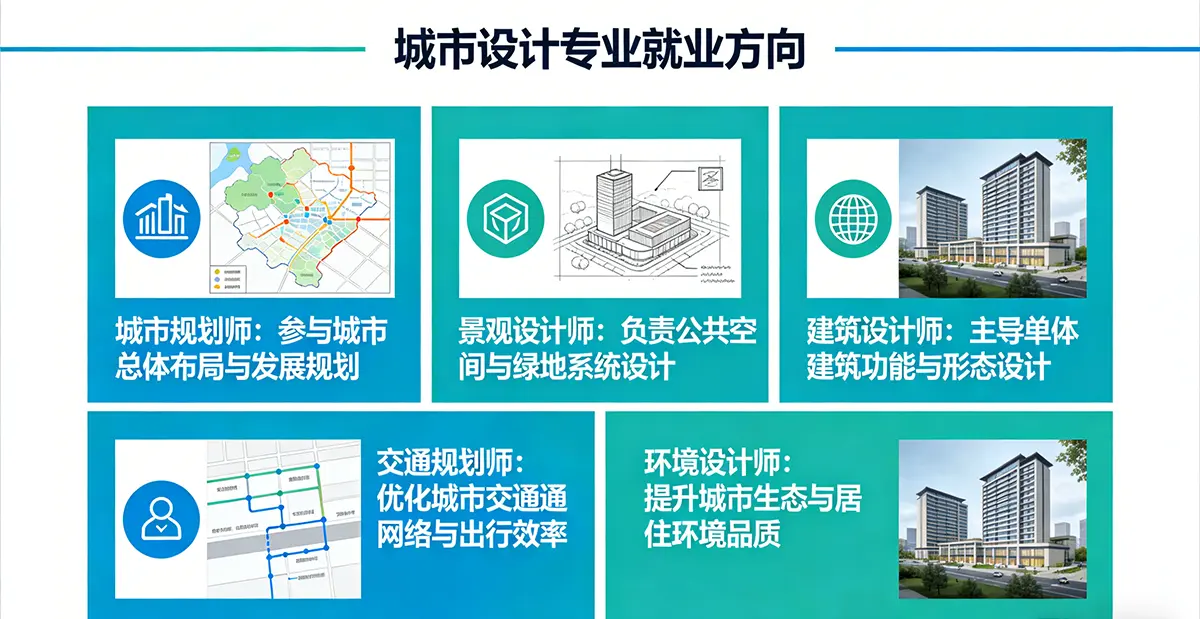
Design Firms (Primary Destination): Architectural design institutes/firms: Urban Designer, Lead Designer, Project Manager. Urban planning design institutes: Planner in Urban Design Departments/Centers (focusing on spatial form). Internationally renowned firms (e.g., SOM, KPF, AECOM, MVRDV): Urban Designer.
Government Departments and Platform Companies: Bureau of Natural Resources and Planning: Civil servant or public institution staff in Urban Design Management divisions. Urban investment/development platforms, major real estate developers: Design Management, Product Development, Investment Expansion roles (responsible for preliminary concept design and design control).
Research and Educational Institutions: Faculty at university schools of architecture and urban planning; researchers at design institutes.
Consulting and Technology Firms: Urban consulting firms: Urban Design Consultant. Smart city technology companies: Spatial Product Manager, Digital City Modeler.
Entrepreneurship: Co-founding urban design/architectural design practices.
5. Employment Rates and Industry Trends for the Urban Design Major
Employment Rate Characteristics:
“Tied to architecture and real estate industry cycles”: Market demand is highly correlated with macroeconomic conditions and land development activity, exhibiting greater volatility than urban planning.
“Portfolio and design capability are central”: Job competitiveness depends almost entirely on portfolio quality, which must showcase exceptional spatial conceptualization, aesthetic sensibility, and graphic communication skills.
“High academic requirements and strong practical focus”: Premium positions typically require a master’s degree and highly value hands-on project experience and software proficiency.
“Moderate starting salary, growth depends on project portfolio”: Entry-level salaries are comparable to top architecture graduates; career advancement is directly linked to the scale, complexity, and impact of projects undertaken.
Industry Trends:
“Stock renewal becomes the main focus”: Shift from large-scale new town design to refined urban repair and weaving—including historic urban core revival, neighborhood micro-regeneration, industrial heritage activation, and TOD integrated development.
“Human-centered approach and return to public space”: Design focus shifts from grand narratives to enhancing pedestrian-friendly environments, neighborhood vitality, community building, and all-age-inclusive public realm quality.
“Integration of digital design and smart scenarios”: Parametric design, generative design, City Information Modeling (CIM), and Virtual Reality (VR) presentations become standard tools; designs must incorporate provisions for future scenarios like smart streets and digital interactive installations.
“Green urban design under dual carbon goals”: Urban ventilation corridors, sponge cities, vertical greening, low-carbon building cluster layouts, and renewable energy utilization become essential design elements.
“Normalization of interdisciplinary and collaborative design”: Projects demand deep collaboration across planning, landscape, transportation, ecology, and other disciplines. Urban designers must possess team leadership and integration capabilities.
“Implementation-oriented policy tool innovation”: Increasing emphasis on translating design intent into actionable regulatory tools like urban design guidelines, zoning plans, and development incentive/transfer policies.
6. Leading Global Institutions Offering the Urban Design Major
(Partial Institutions Displayed - Ranking Not in Order)Urban design is typically offered as a major specialization within architecture or urban planning programs, with top institutions primarily located in countries with strong architectural traditions.
| Country/Region | Representative Institutions (Leading Urban Design Programs) |
| United States | Harvard University (GSD, Urban Design), Massachusetts Institute of Technology (MIT, City Design and Development), University of California, Berkeley (UCB), Columbia University (GSAPP), University of Pennsylvania (PennDesign) |
| United Kingdom | University College London (UCL, The Bartlett), University of Cambridge, University of Sheffield, Cardiff University, Architectural Association School of Architecture (AA) |
| Europe | Delft University of Technology (TUD), ETH Zurich, Politecnico di Milano (Polimi), Technische Universität Berlin (TUB) |
| Australia | The University of Sydney, University of New South Wales (UNSW) |
| China | Tongji University (College of Architecture and Urban Planning, top-tier domestically), Tsinghua University (School of Architecture), Southeast University (School of Architecture), Tianjin University (School of Architecture), South China University of Technology (School of Architecture) |
| Hong Kong/Singapore | The University of Hong Kong, National University of Singapore (NUS) |
DisciplineMajor Recommendations
Ideal Candidates for the Urban Design Major:
Individuals with keen observational skills and a strong desire to shape the scale, form, atmosphere, and human activities within urban spaces. Those who combine macro-level strategic thinking with micro-level spatial insight, capable of conceptualizing overall structures while refining details like street furniture. Possessing excellent three-dimensional spatial imagination, graphic communication skills, and model-making abilities. They are effective communicators, coordinators, and team players who can drive design implementation within multidisciplinary collaborations.
Core Competencies for the Urban Design Major:
Systematic design creativity for constructing the three-dimensional spatial form and place identity of urban districts. The ability to clearly and vividly express complex design intentions through drawings, models, digital media, and other means. Capacity to understand and reconcile urban planning objectives, architectural design requirements, development economics, and public interests. Proficiency in utilizing cutting-edge digital design tools for innovative design solutions.
Learning Recommendations for the Urban Design Major:
“Read the city with your feet, document your thoughts with sketches”: Cultivate the habit of walking, observing, sketching, and analyzing within the urban environment to build your personal spatial knowledge base.
“Prioritize and fully commit to the Studio”: Devote maximum effort to core design studio courses to produce high-quality, in-depth design proposals.
“Master a comprehensive digital workflow from analysis to presentation”: For example, GIS + Rhino + Grasshopper + Adobe Creative Suite + UE/Enscape.
“Study classics while staying current”: Read seminal works by authors like Jane Jacobs and Kevin Lynch intensively, while also following the latest award-winning urban design projects globally.
“Gain real-world project experience early”: Intern at design institutes or firms to understand industry standards, workflows, and client requirements.
“Develop economic and policy awareness”: Proactively learn about land policies, development indicators, floor area ratio incentives, etc., to enhance the feasibility and implementability of your designs.
Note: Some institutions may categorize this major under different disciplines. Please refer to the specific classification used by the institution in question.
- The Previous Passage:Urban Planning(Urban Plan. 或 UP)_城市规划学
- The Next Passage:Landscape Architecture(Landscape Arch. 或 LA)_风景园林学

Communication Engineering(Commun. Eng.)_通信工程
Communication Engineering Major Communication engineering Major serves as a bridge connecting the wo···

Human Geography Major_Geography(Geog.)_人文地理
The Human Geography Major explores the complex relationships between human activities and space, cul···

Atmospheric Sciences(Atmos. Sci.)_大气科学
Atmospheric science is the study of phenomena and evolutionary patterns within Earth's atmospher···
Ship and Ocean Engineering(Ship Ocean Eng.)_船舶与海洋工程
Naval Architecture and Ocean EngineeringNaval Architecture and Ocean Engineering is a core engineeri···

